
Greetings and welcome to a brand new Flute Friday! I know….it’s been a hot minute. I spent the summer teaching, performing, and encouraging students to live their best flute lives. I also traveled to the National Flute Association Convention in Atlanta to talk about Flute Friday and the power that this little blog has had to connect with so many other awesome musicians doing incredible things over the years. Hosting Flute Friday has been one of the best and most unexpected parts of my flute career. I sincerely hope that other flutists try their hand at blogging! If you are one of these flutists, and have a great idea for a blog but aren’t sure about next steps, DM me. I would love to help a new generation of bloggers begin their journeys.
For most of us, a new school year is either already on its way or just around the corner. Time to get back to work! For young flutists, that means time to practice. I know…just that word “practice” evokes long, tiring hours packed into a small room, staring at unending Taffanel and Gaubert scales. You may also be required to turn in practice cards to your teachers once again. Instead of procrastinating on your focused flute time, let’s make this year your best practice year ever! Imagine what you could do this year with a really practical, easy to manage practice plan. You could win that important competition. You could host that recital with those scary technical pieces you’ve always wanted to play. You could apply to that orchestra with the opening you’ve had your eye on. You could even audition for one of those NFA competitions you see advertised on Instagram. The sky is the limit! But first…you’ve got to practice. And even before that….you need to have a practice plan. In today’s blog, I am sharing my time-tested practice routine structure. This is the best place to start! Organize your practice so that it serves your goals and uses your time efficiently.
When I was a kid, I was obsessed with practicing. I grew up on a tree farm and when the weather was decent, I would practice for hours in our barn. But my practicing was random. What were we working on in Band class? Okay, I will practice that. What books/exercises did my flute teacher assign? Okay, I will practice that too. But I did not practice with goals in mind and time was measured by the sun (Is it almost dark? Time to pack up!). In middle school, my band director gave me a pamphlet written by Richard Hahn (flute teacher at the University of Idaho at the time) discussing how best to organize your practice time. Long tones, scales, etudes, band repertoire, and solo repertoire. Light bulb! This little pamphlet served as my practice structure throughout middle and high school. It was very easy to follow and helped me put as much time into strengthening fundamentals (sound, technique) as I did mastering complicated runs in my band music. As an adult, however, I ran into the obstacle of time. I have been borderline obsessed with time management books and videos for decades, trying to find the best way to do all of things in all aspects of life all at once. LOL! What have I discovered? You guessed it: We can’t do all of the things at once without sacrificing our health or without some of the things only yielding C+ grade level work. I spent a long time burned out. In my state of exhaustion, I ignored my flute. I practiced only when I could find time to cram practice before a performance. Not good. And did I revert back to my balanced, high school, Richard Hahn-inspired routine? Nope. Cram practicing does not have a routine. I slipped into bad habits that did not help my flute playing or move me forward in my career.
Stuck. Without a plan.
I realized I had to go back to my roots. But with a twist! The twist of time.
I rebooted that old framework, tweaking it slightly to include other fundamentals I wanted to cultivate. I added improv to practice playing creatively and Alexander Technique to alleviate tension. I realized how much time I realistically had to practice on daily basis and began setting timeframes into my routine. This meant that if I only had an hour to practice per day, I might set a timer to only work on long tones for 5 minutes, scales for 5 minutes, etudes for 10 minutes, and spend only 10 minutes of focused practice time on each piece of repertoire, ending of course with a few minutes for improv and reflection. Before I began practicing, I would set 1-3 goals for what I wished to accomplish by the end of my practice session. I wrote it all down before I began even putting my flute together. What I discovered is that my flute playing improved tenfold! I was able to achieve a balanced routine in a reasonable amount of consistent practice that was focused on my goals.
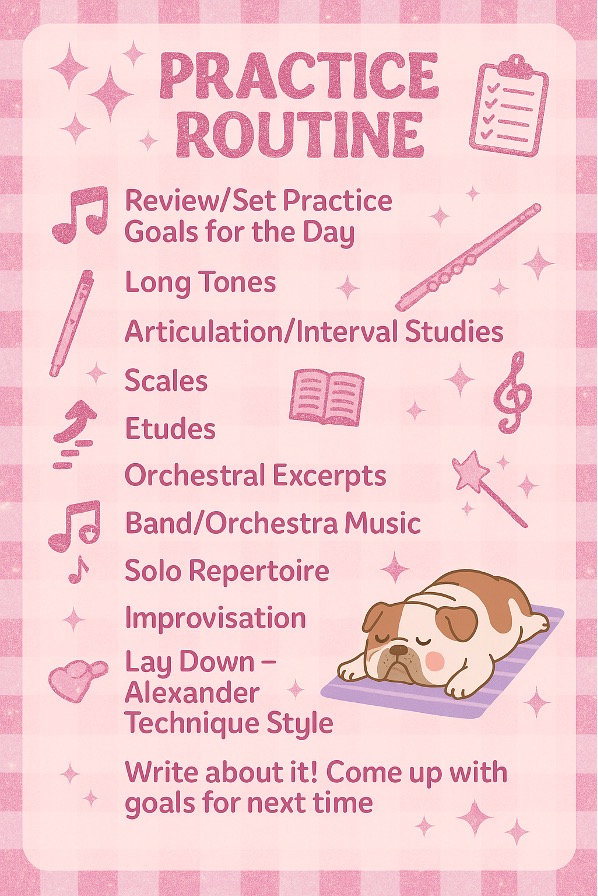
I continue to use my new/improved framework and regularly share it with my students. I created the below graphic to help remind them how they can best structure their own practice routines. Print this out! Place it on your music stand! Use it as your iPad background. A practice session is only as good as the plan you use to make it happen.
One of the most important things to remember is that practice doesn’t have be Practice (with a capital P). “Practice” makes us think of work which makes most of us want to run for the hills. Practice is not practice. It is play. It is experimentation. It can also be a game. How much better can you play the flute today compared to yesterday? What did you discover about your flute playing today that you didn’t know until now?
How do you structure your practice routine? Has your routine changed throughout the years? Do you set timers? Do have any time to practice creatively? Please comment below!
Happy fluting (and happy practicing)!

 Rachel Taylor Geier
Leave a comment